AI Use Cases: 10 Working Demos You Can Actually Watch

Most articles about AI use cases are lists of things AI could theoretically do. This one is different. Every use case below is a system we have built and recorded, so instead of reading a description you can watch it run.
We put this together because the gap between “AI can do this” and “here is what it looks like on a Tuesday afternoon with real data” is where most projects get lost. A demo removes the ambiguity. You see the input, the processing, and the output, and you can judge for yourself whether it solves a problem you actually have.
Each section below is a short summary. Each links to a full breakdown with the demo video, how the system works, what it costs in time and effort to build, and where it breaks.
How to read this list
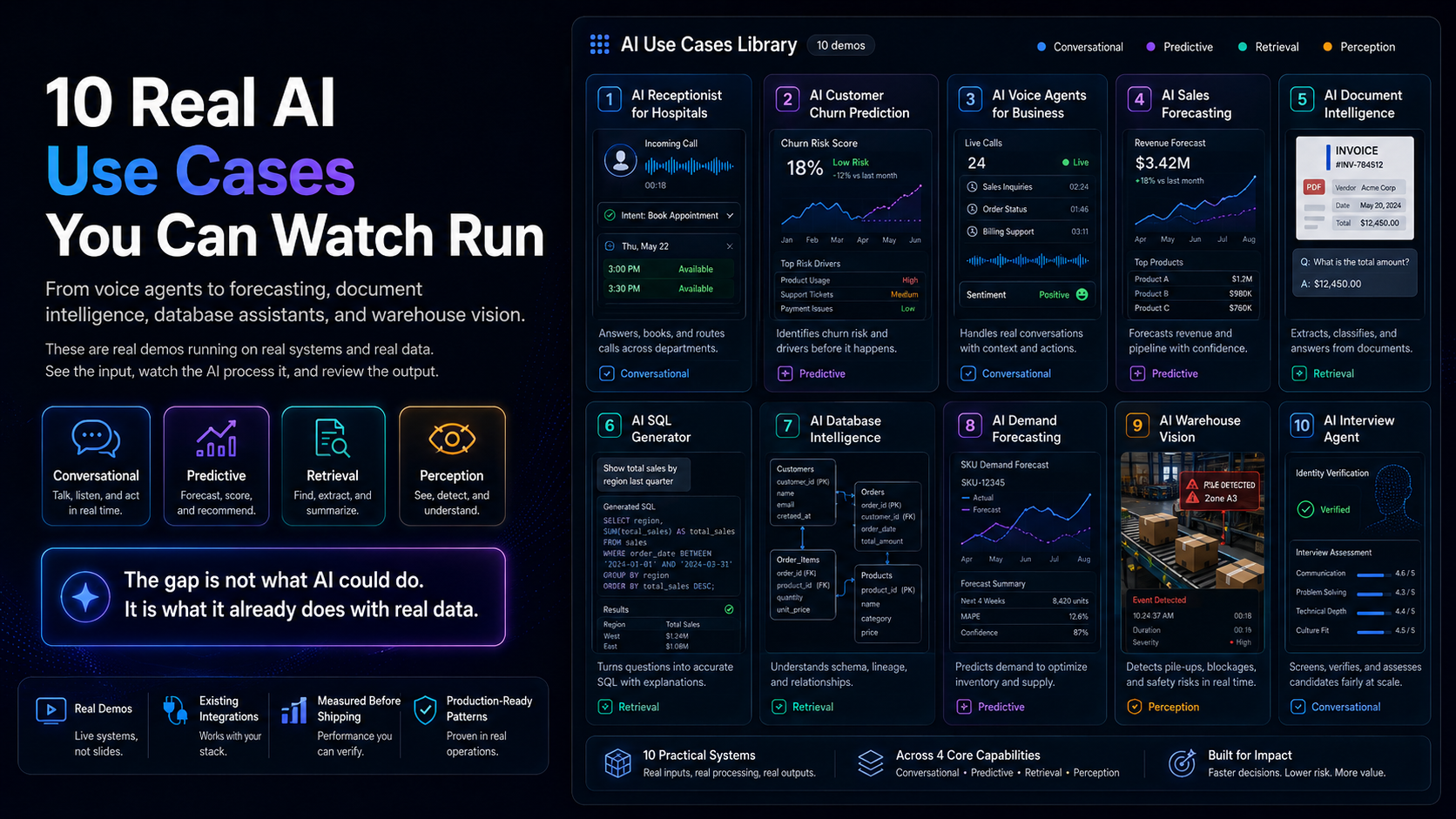
The use cases fall into four families, and it is worth knowing which family you are shopping in, because they have very different implementation profiles.
Conversational systems replace or augment a human conversation. Voice agents and interview agents live here. They are the most visible to end users and the most sensitive to quality, because people notice immediately when a conversation goes wrong.
Predictive systems find patterns in historical data and score what happens next. Churn prediction, sales forecasting, and demand forecasting live here. These are the least glamorous and often the highest return, because a small accuracy improvement compounds across every decision.
Retrieval systems let people ask questions of documents and databases in plain language. Document intelligence, SQL generation, and database assistants live here. They are the fastest to demonstrate value and the easiest to get subtly wrong, because a confident wrong answer is worse than no answer.
Perception systems interpret images or video. Warehouse vision lives here. They require the most infrastructure but solve problems no other approach can touch.
1. AI Receptionist for Hospitals
Healthcare facilities miss a significant share of inbound calls outside business hours, and each missed call is a patient who books somewhere else. This demo shows an AI receptionist answering a call, checking real doctor availability, offering alternative slots, and completing a booking end to end without a human involved.
Best for: hospitals, clinics, dental practices, diagnostic labs, multi-location networks.
Read the full breakdown: AI Receptionist for Hospitals
2. AI Customer Churn Prediction
Most companies discover churn after it happens, when the cancellation email arrives. This demo takes a customer CSV and scores who is likely to cancel in the next 30 to 60 days based on tenure, usage, billing, and support history, then explains the reasoning behind each individual score.
Best for: SaaS, subscription businesses, telecom, insurance, any recurring revenue model.
Read the full breakdown: AI Customer Churn Prediction
3. AI Voice Agents for Business
A single showcase covering four live calls across real estate, healthcare, e-commerce, and banking. Useful if you want to understand what voice AI sounds like across different conversation types before committing to one use case.
Best for: any business where the phone is a revenue channel.
Read the full breakdown: AI Voice Agents for Business
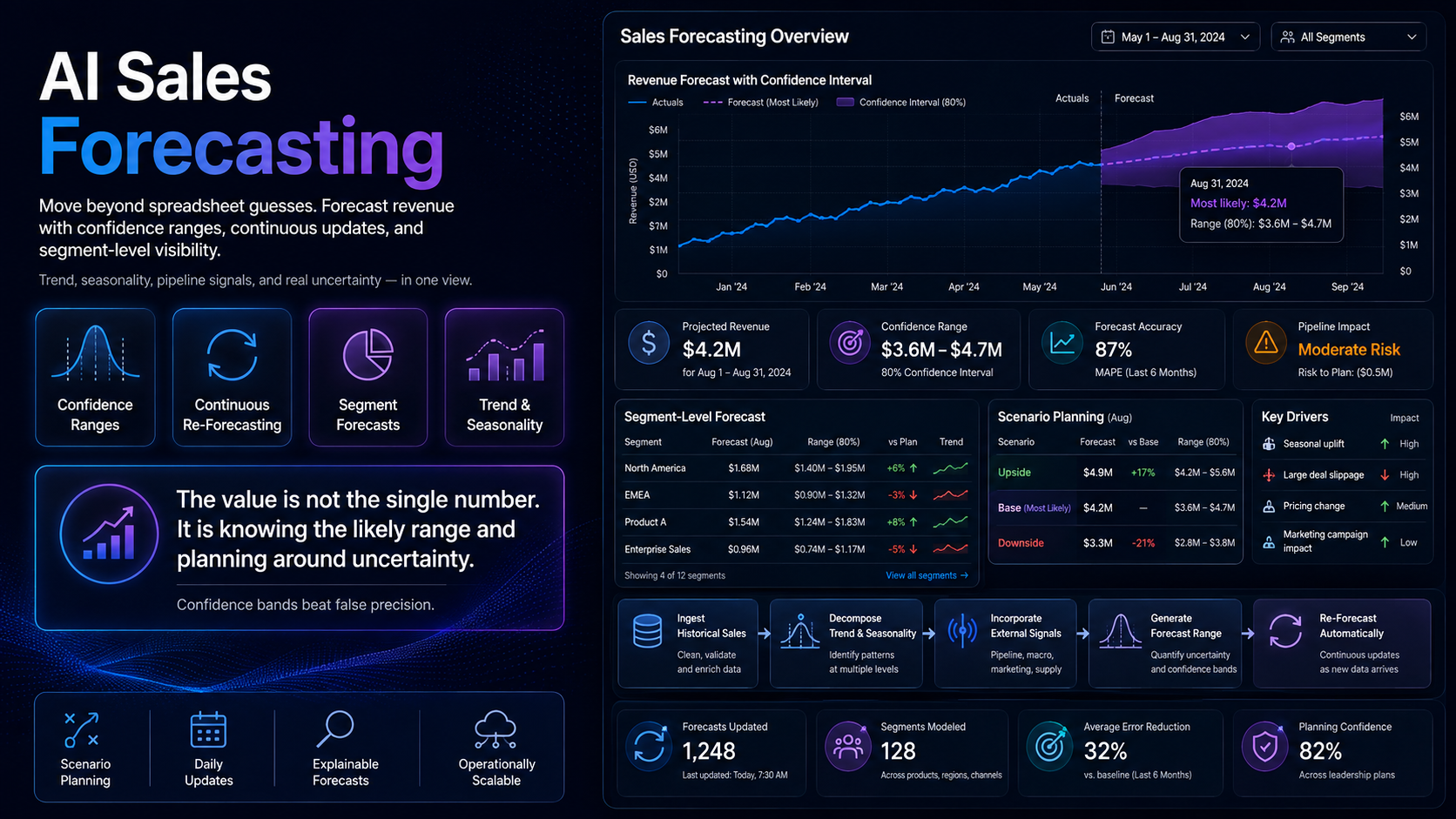
4. AI Sales Forecasting
Sales forecasts built in spreadsheets are usually a quarter behind reality. This demo shows a forecasting platform that ingests historical sales and produces continuously updated projections with confidence ranges rather than a single optimistic number.
Best for: sales leadership, finance, operations planning.
Read the full breakdown: AI Sales Forecasting
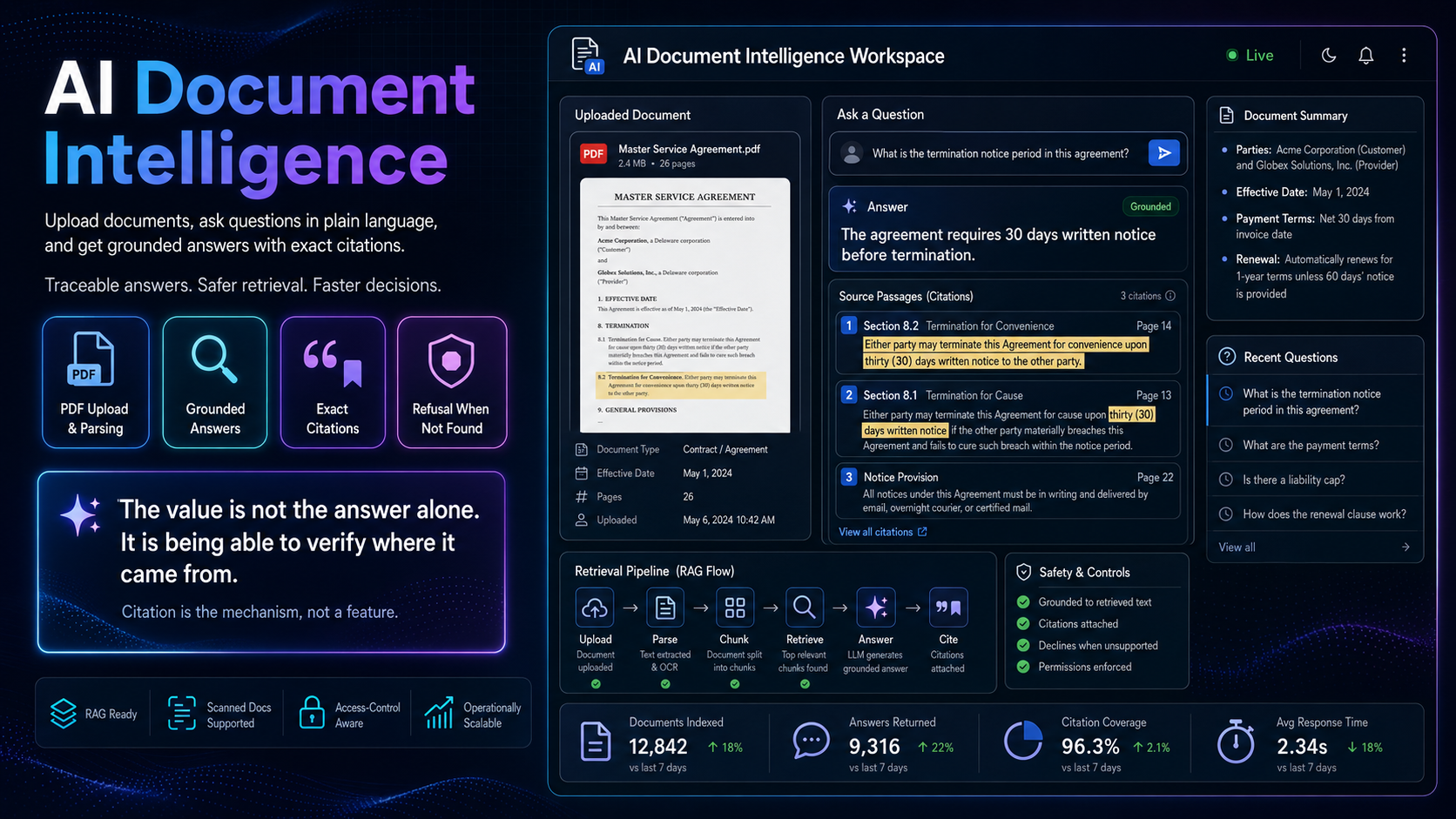
5. AI Document Intelligence: Chat With Any PDF
Upload a PDF and ask questions of it in plain language. The system answers from the document and cites the exact passage it used, which is the difference between a research tool and a liability.
Best for: legal, compliance, insurance, internal knowledge management, support teams.
Read the full breakdown: AI Document Intelligence
6. AI SQL Generator
Ask a question in English, get a working SQL query against your schema. This removes the analyst bottleneck for routine questions, which is usually where the real cost sits.
Best for: data teams, operations, anyone who waits days for a simple report.
Read the full breakdown: AI SQL Generator
7. AI Database Intelligence
A step beyond query generation. The system maps your database, generates an entity relationship diagram, and answers questions about the structure and contents together.
Best for: teams inheriting a legacy database, data governance, onboarding new engineers.
Read the full breakdown: AI Database Intelligence
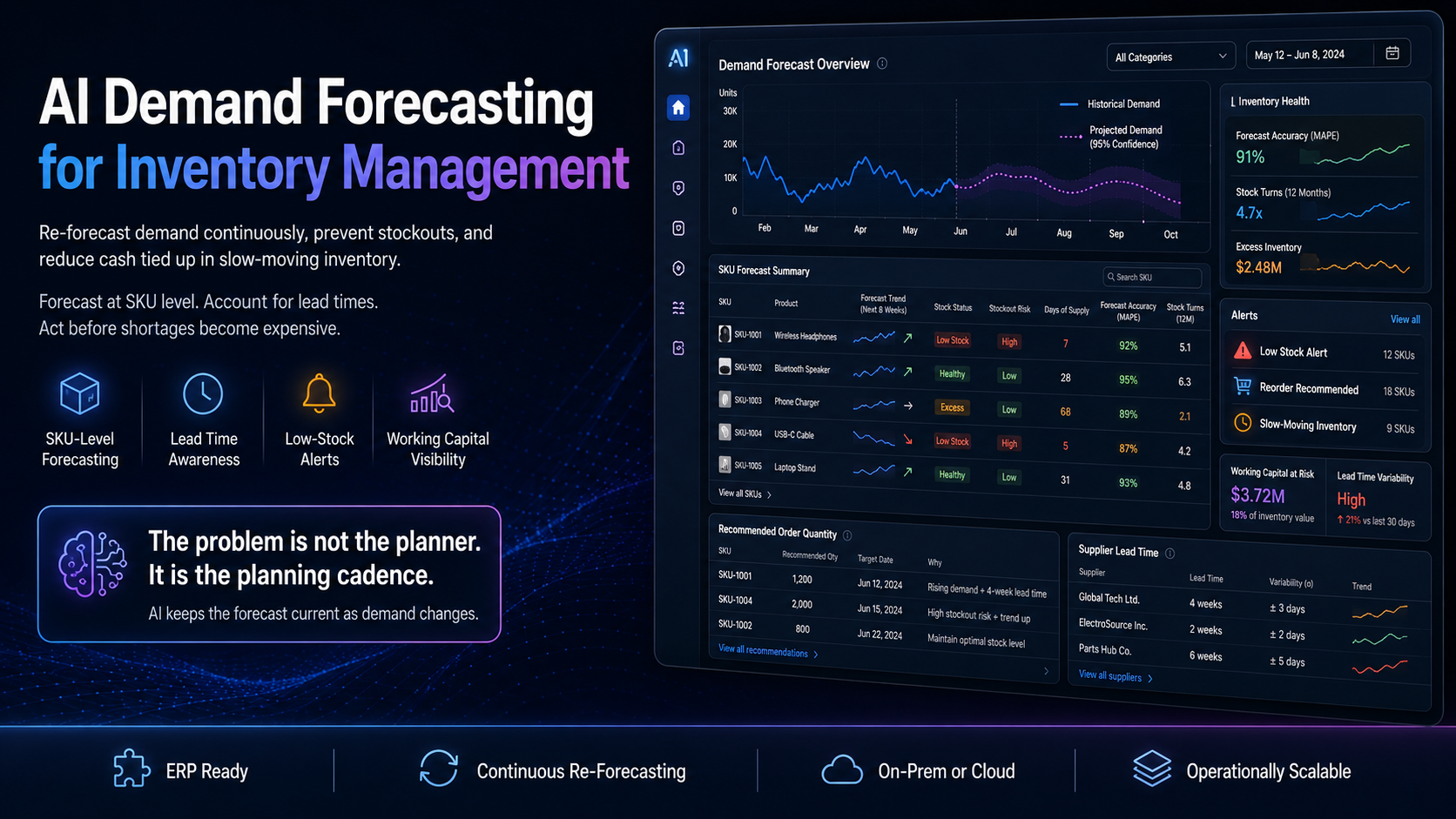
8. AI Demand Forecasting for Inventory
Inventory is where mid-sized manufacturers and retailers quietly lose the most money, through stock that sits unsold or runs out at the wrong moment. This demo shows continuous re-forecasting against live signals rather than a plan built once a quarter.
Best for: manufacturing, retail, distribution, supply chain.
Read the full breakdown: AI Demand Forecasting
9. AI Warehouse Vision
Live camera feeds analysed by a computer vision model that flags conveyor pile-ups as they form, so the alert arrives before the damage, downtime, or missed dispatch window.
Best for: warehousing, logistics, fulfilment centres, manufacturing lines.
Read the full breakdown: AI Warehouse Vision
10. AI Interview Agent
A conversational AI that conducts a structured interview, asks relevant follow-up questions, and returns a structured evaluation rather than a raw transcript. It also verifies that the person on camera matches the person who is supposed to be interviewing, which addresses a growing problem in remote hiring.
Best for: recruitment, high-volume hiring, technical screening.
Read the full breakdown: AI Interview Agent
What these demos have in common
Three things are true of every system above, and they are worth stating because they are the difference between a demo and something that survives contact with a real business.
They are measured before they are shipped. Each was built against a defined success metric. If you cannot describe what “working” means as a number, you cannot tell whether the system is helping.
They integrate rather than replace. None of these require you to abandon the tools you already run. They plug into existing calendars, CRMs, databases, and phone systems, because rip-and-replace projects are the ones that stall.
They handle being wrong. Retrieval systems cite sources and refuse to answer outside their documents. Predictive systems give confidence ranges, not single numbers. That design choice matters more than raw model quality.
If you want the reasoning behind how we scope and sequence this kind of work, our AI transformation roadmap and our breakdown of why most AI projects stall cover it in depth. If you are weighing whether to build in-house or bring in a partner, the build vs buy TCO framework is the practical version of that decision.
Frequently asked questions
How long does it take to build something like these?
Most of the systems above run four to twelve weeks from scoping to production, depending on data access and integration complexity. The build itself is rarely the long pole. Getting clean access to real data usually is.
Do we need our own data scientists?
Not to run these. You need someone who understands the process being automated and can define what success looks like. The engineering can be brought in.
Are these off-the-shelf products?
No. They are demonstrations of systems built for specific problems, using our own data and environments. The architecture is reusable, the configuration is specific to each business.
What data do we need to get started?
It varies by use case. Predictive systems need historical records with outcomes. Retrieval systems need the documents or database. Conversational systems need access to whatever they will book into or query. Each linked article lists the specifics.
AINinza is the AI practice of Aeologic Technologies, backed by over a decade of enterprise engineering. If one of these use cases maps to a problem you are working on, we are happy to talk through what it would take, including whether it is worth doing at all.