AI Document Intelligence: How Chatting With Your Documents Works

Every organisation sits on documents nobody reads. Contracts, policies, manuals, regulatory filings, past proposals, support documentation. The information is there, it is just not accessible at the moment someone needs it, which functionally means it does not exist.
The obvious answer is to ask a question and get an answer. The non-obvious part is doing that without the system inventing things, which is the difference between a useful tool and a liability.
This article explains how AI document intelligence works, why citation is the whole mechanism rather than a nice feature, and where these systems fail.
Watch the demo
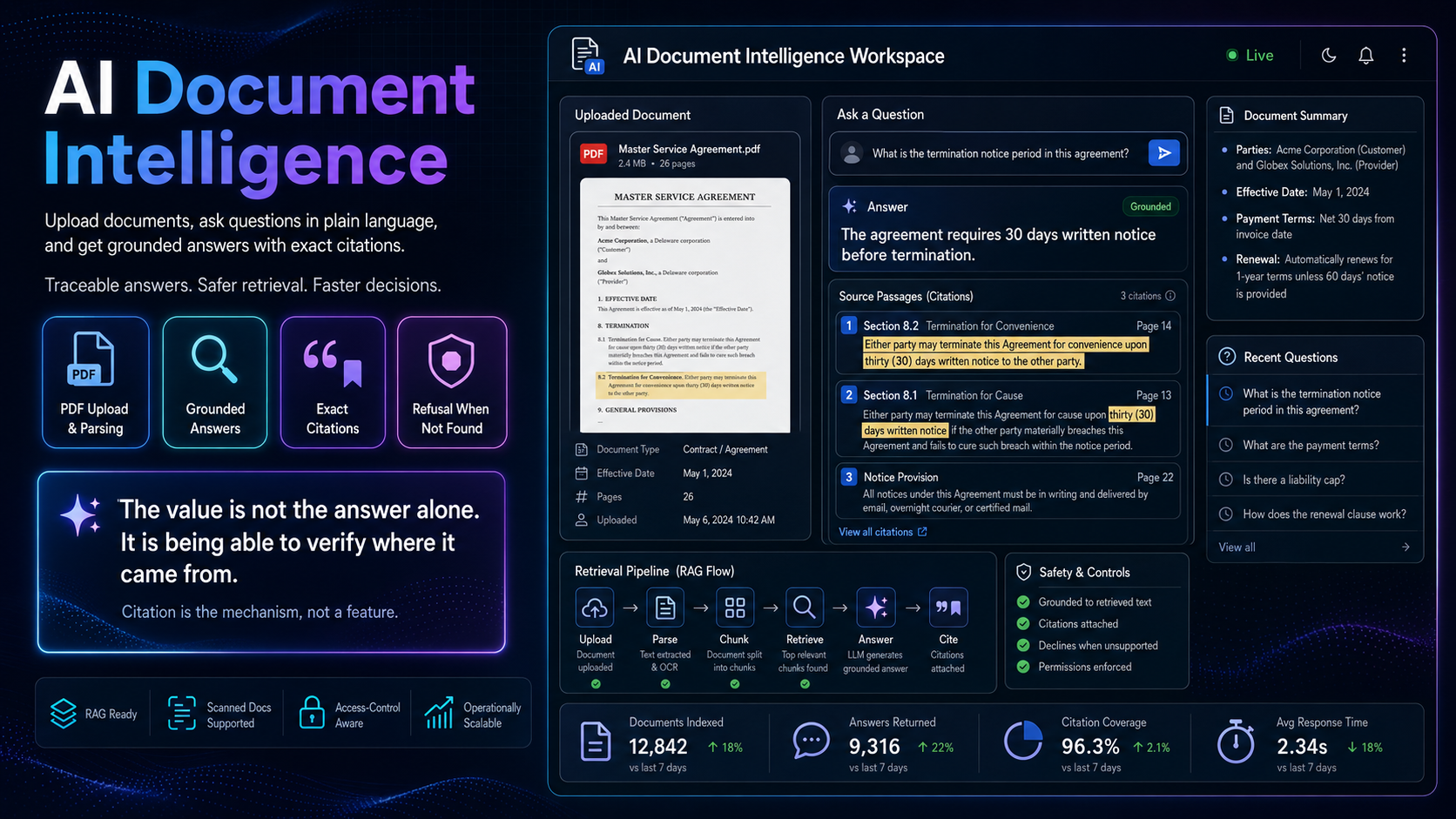
The demo shows a PDF uploaded and questioned in plain language. The system summarises the document, answers specific questions about its contents, and cites the exact passage each answer came from.
Why a general chatbot is not enough
If you paste a contract into a general-purpose AI assistant and ask about the termination clause, you will get a fluent answer. The problem is that you cannot easily tell whether it came from your contract or from the model’s general knowledge of what termination clauses usually say. Those are very different things, and the second one is dangerous when the answer feels authoritative.
AI document intelligence systems are built to remove that ambiguity. The design goal is not fluency. It is traceability.
How it works: retrieval-augmented generation
The architecture behind most document intelligence systems is retrieval-augmented generation, usually shortened to RAG. It is worth understanding in outline, because the quality differences between implementations happen at specific steps.
1. Ingestion and parsing
The document is read and converted to structured text. This is less trivial than it sounds. Scanned PDFs need optical character recognition. Tables lose meaning when flattened badly. Multi-column layouts get read in the wrong order. A large share of poor results trace back to parsing failures rather than the model.
2. Chunking
The text is split into passages. Chunk too small and you lose context, so a clause gets separated from the definition it depends on. Chunk too large and retrieval gets imprecise. Sensible systems chunk along document structure, keeping sections and clauses intact rather than cutting every 500 characters.
3. Embedding and indexing
Each chunk is converted into a numerical representation capturing its meaning, then stored in a vector index. This is what allows searching by meaning rather than keyword, so a question about “getting out of the agreement early” finds a clause headed “termination for convenience”.
4. Retrieval
When a question arrives, the system finds the passages most likely to contain the answer. Retrieval quality sets the ceiling on answer quality. If the right passage is not retrieved, no model can produce a correct answer from what it was given.
5. Generation, constrained to the source
The retrieved passages and the question go to the language model with an instruction to answer only from the supplied material and to say so when the answer is not present. This constraint is the entire safety mechanism.
6. Citation
The answer links back to the specific passages used. This lets the reader verify in seconds, which converts the system from something you have to trust into something you can check.
Why citation is the mechanism, not a feature
The most common question about these systems is whether they hallucinate. The honest answer is that any language model can produce plausible text that is not true. What changes the risk profile is architecture.
A properly built document system does three things: it grounds every answer in retrieved passages, it cites those passages, and it refuses to answer when nothing relevant is retrieved. That third behaviour is the hardest to get right and the most valuable. A system that says “this document does not appear to address that” is far more useful than one that produces a confident guess.
If you are evaluating a vendor, test the refusal behaviour specifically. Ask something the documents genuinely do not cover and see what happens. Fluent invention there tells you what you need to know.
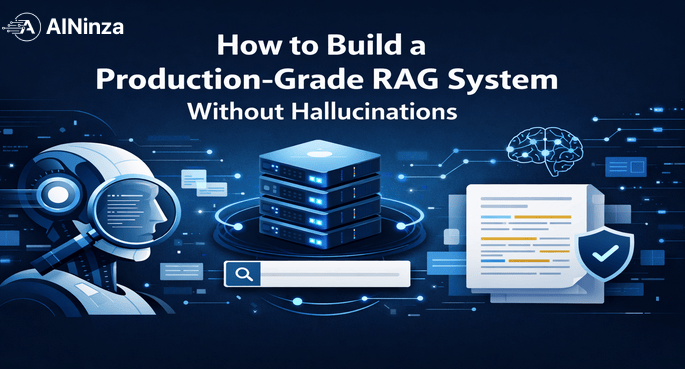
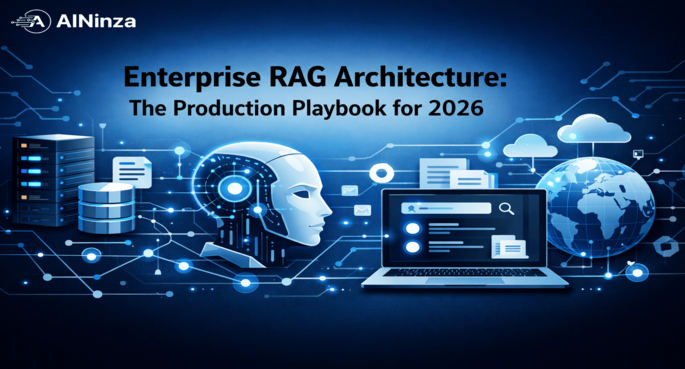
For the deeper engineering treatment, our guide on building production-grade RAG without hallucinations covers the techniques in detail, and enterprise RAG architecture covers scaling it.
Where these systems fail
Bad parsing poisons everything. If the PDF is a low-quality scan, or tables are mangled during extraction, no downstream cleverness recovers the meaning. Test with your worst documents, not your cleanest.
Questions spanning many documents. Retrieval works well when the answer sits in a few passages. “Summarise the risk profile across all 400 contracts” is a fundamentally different problem, and systems that appear to handle it are often sampling rather than reading everything.
Reasoning across scattered facts. If the answer requires combining information from six places and performing a calculation, reliability drops. These systems are strong at finding and summarising, weaker at multi-step synthesis.
Documents that contradict each other. When a policy has three versions across five years, the system may retrieve the wrong one. Recency and version metadata need to be part of the index, not an afterthought.
Access control. If everyone can query everything, you have created a data exposure problem. Permissions must apply at retrieval, so a user only ever gets answers from documents they are entitled to read.
What it is genuinely good for
- Contract and policy lookup. Finding a specific clause across a large library in seconds rather than hours.
- Support and internal knowledge. Answering the recurring questions that consume a support team’s day, with sources attached.
- Compliance review. First-pass checks against documented requirements, with a human confirming.
- Onboarding. New staff asking questions they would otherwise interrupt a colleague to ask.
- Due diligence. First-pass review of a document room to flag items needing human attention.
The pattern across all of these is that the system does the finding and drafting, and a person retains the judgement.
What deployment looks like
Four to eight weeks.
Week 1. Pick a document set and a user group. Not all documents. The narrower the scope, the better the first version. Define what a good answer looks like.
Week 2. Build the evaluation set: a list of real questions with known correct answers. This is what you measure against, and building it before the system is what keeps the project honest.
Weeks 3 to 5. Build ingestion, chunking, retrieval, and the answer layer, testing against the evaluation set continuously.
Week 6. Pilot with real users asking real questions, which will surface failure modes no test set anticipated.
Weeks 7 to 8. Tune retrieval, handle the failures found, and decide about widening the document scope.
Related use cases
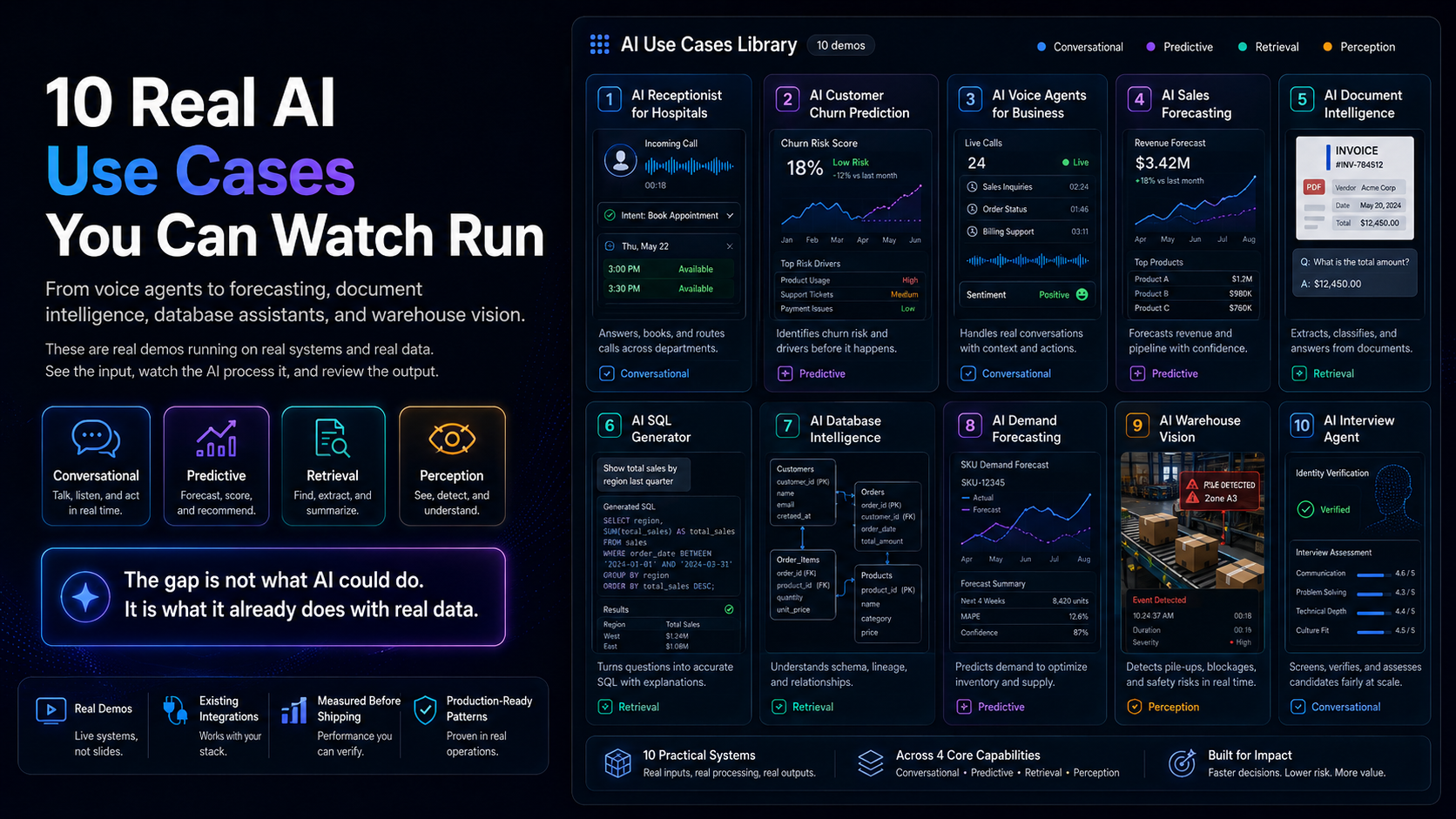
If your questions are about structured data rather than documents, AI SQL generator and AI database intelligence solve the equivalent problem for databases.
Browse everything in our AI use cases library.
Frequently asked questions
Will it make things up?
A well-built system grounds every answer in retrieved passages, cites them, and declines when nothing relevant is found. Test the refusal behaviour before you trust any implementation.
How many documents can it handle?
Retrieval architectures scale to very large collections. The practical constraints are ingestion quality and access control rather than raw volume.
Does it work with scanned documents?
Yes, with optical character recognition, though quality depends heavily on the scan. Poor scans produce poor text and therefore poor answers.
Can it handle documents in multiple languages?
Yes, including asking in one language about a document written in another, though quality varies by language pair and should be tested on your own material.
Where does our data go?
This is the question to settle first. Deployment options range from fully self-hosted to managed services, with meaningfully different data handling. For sensitive material, decide this before evaluating features.
How is this different from search?
Search returns documents. This returns answers, with the source attached. For a question like “what is our notice period in the Acme contract”, the difference is between a list of files and a sentence you can verify.
AINinza is the AI practice of Aeologic Technologies, backed by over a decade of enterprise engineering. If your team loses hours to finding things inside documents, we are happy to talk through what a grounded, citable system would take.