
AI Calling Compliance: TCPA, TRAI DND and GDPR Rules for Outbound Voice Agents

In February 2024, the US Federal Communications Commission answered a question every team building a voice AI agent needs to ask. A voice generated by AI counts as an “artificial” voice under the Telephone Consumer Protection Act (TCPA). So an AI voice agent that dials customers is held to the same rules as a robocall.
The US isn’t alone. India’s telecom regulator now names “artificial voice technologies” in its rules for automated calls, and the EU has required consent for automated marketing calls for years. If you plan to use an AI voice agent for outbound calls, AI calling compliance is part of the build, not something to sort out after launch.
This guide covers what the rules in the US, India and the EU ask for, and how to design the agent so it meets them. Laws are summarised as of November 2026.
This is general information, not legal advice. Telemarketing rules change often and depend on where you and the people you call are. Check your plans with a lawyer who knows the countries you call.
Why an AI calling agent gets the strictest treatment
None of the three regions has a separate law just for AI phone calls. Each one already had strict rules for calls placed by machines, and AI voice agents fall inside them.
- United States: the TCPA restricts calls that use an “artificial or prerecorded voice”. The FCC has confirmed that AI-generated voices are included.
- India: the Telecom Regulatory Authority of India (TRAI) defines an “A2P call” (application-to-person call) as a voice call started by software without a person dialling, including “pre-recorded/artificial voice technologies”.
- European Union: the ePrivacy Directive covers “automated calling and communication systems without human intervention” used for direct marketing.
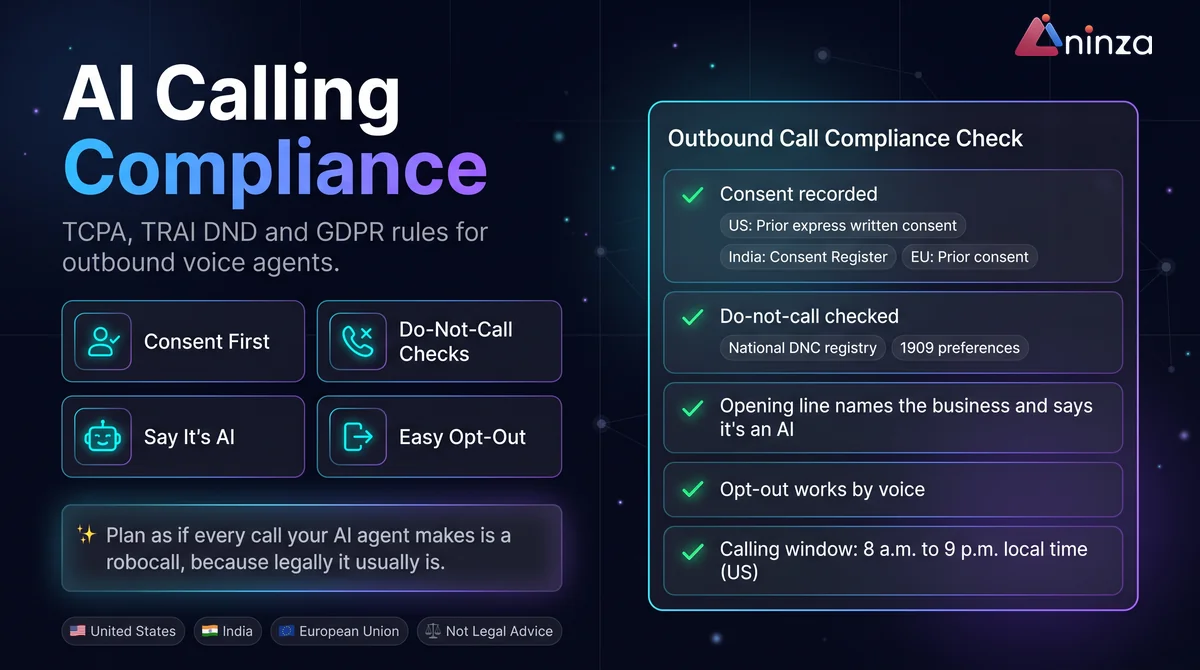
In practice, that means the rules a human call-centre agent works under are the wrong starting point. Plan as if every call your AI agent makes is a robocall, because legally it usually is.
United States: the TCPA and AI voices
The FCC’s declaratory ruling of February 2024 (FCC 24-17) confirms that the TCPA’s limits on “artificial or prerecorded voice” calls cover current AI technologies that generate human voices. As a result, the FCC says, these calls need the prior express consent of the person called.
The detailed rules sit in the FCC’s regulations at 47 CFR 64.1200. These are the parts that matter most for an AI calling agent.
Consent depends on what the call is for
For calls to mobile numbers using an artificial voice, you need the person’s prior express consent, with narrow exceptions such as emergencies. If the call is telemarketing or includes an advertisement, the bar is higher: prior express written consent. The same written consent is needed for artificial-voice telemarketing calls to home landlines.
Written consent has a specific meaning. It is a signed agreement that clearly authorises the seller to make these calls, names the phone number it applies to, and tells the person they don’t have to agree as a condition of buying anything. A pre-ticked box buried in your terms is a weak foundation for an outbound AI campaign.
What every artificial-voice call must say
At the start of the message, the call must clearly state the identity of the business responsible for it. During or after the message, it must give a phone number for that business.
Telemarketing calls with an artificial voice also need an automated opt-out that works during the call, by voice or keypress. When someone uses it, their number must be added to your do-not-call list and the call must end straight away. For an AI agent, this is a design requirement: “stop calling me” has to work as reliably as “yes, book it”.
Do-not-call lists and calling hours
Telephone solicitations can’t be made to residential numbers before 8 a.m. or after 9 p.m., in the called person’s local time. They also can’t go to numbers on the national do-not-call registry. On top of that, you need your own company do-not-call list, a written policy for keeping it, and training for the people who run your calls.
People can withdraw consent any way that is reasonable
Under the current rules, a person can revoke consent “by using any reasonable method”. You can’t make one channel the only way to opt out, and you must honour the request within a reasonable time, no later than ten business days. If your agent hears “please don’t call me again”, treat that as a revocation and record it.
This section covers the federal rules only. Check the telemarketing laws of the states you call as well.
India: TRAI’s DND rules for automated calls
In India, commercial calls are governed by the Telecom Commercial Communications Customer Preference Regulations, 2018 (TCCCPR). The current regulations and amendments are published on TRAI’s website. TRAI amended them in February 2025 and twice more in 2026, in September and November, so check for new changes before each campaign.
The DND registry decides who you can call with promotions
Indian mobile users can block commercial communication by calling or sending an SMS to 1909, or by dialling a USSD code such as *1909*0# to block everything except service, transactional and government messages. They can also block single categories, such as banking, real estate, education or health.
A promotional voice call can only go to people who haven’t blocked that category, or who have given their consent in the Consent Register. If you hold explicit digital consent from the person, recorded through the official process, the call can be delivered even if they have blocked promotions.
Don’t mix a sales pitch into a service call
This rule matters for AI agents in particular. Under the 2025 amendment, if promotional content is mixed into any type of commercial voice call, the whole call is treated as a promotional call. An agent that confirms a delivery and then offers a discount has turned a service call into a promotional one, with the stricter rules that come with it.
Service calls themselves are defined narrowly: information about a product or service the customer already has, such as delivery updates, warranty, safety alerts or balance alerts.
Use the right number series
In its explanatory memorandum to the 2025 amendment, TRAI says promotional calls through auto-dialers or robocalls should use 140-series numbers only, and service and transactional robocalls should use 1600 or another series allotted for that purpose.
New in 2026: declare your A2P calls in advance
TRAI’s Third Amendment Regulations of 2026, notified on 18 September 2026, added the A2P call definition quoted above. It also requires every business (TRAI calls them “Senders”) to declare in advance to its originating telecom operator that it uses A2P calls, with the calling number ranges it will use. The operator records this on the DLT platform, the distributed ledger technology system Indian operators use to register commercial senders.
Any A2P call made without that declaration is treated as unsolicited commercial communication, which is the formal term for spam. The amendment says this rule comes into force 60 days after the amendment’s publication in the Official Gazette. If you run an AI calling agent in India, confirm with your operator that the declaration is in place.
India’s data protection law still applies
The 2026 amendment also states that nothing in these regulations exempts a business from its duties under the Digital Personal Data Protection Act, 2023. Telecom consent and data protection consent are two separate things, and you need to get both right.
European Union: GDPR, ePrivacy and the AI Act
In the EU, three laws overlap on an AI calling agent.
ePrivacy: consent before automated marketing calls
Article 13(1) of the ePrivacy Directive (2002/58/EC, as amended) allows automated calling systems to be used for direct marketing only to people who have given their prior consent. Because it is a directive, each EU country writes it into its own national law, so the details depend on the country you are calling.
GDPR: consent has to be real, and easy to take back
The GDPR applies to the personal data your agent uses: phone numbers, names, call recordings and transcripts. Under Article 4(11), consent must be freely given, specific, informed and unambiguous, shown by a statement or a clear affirmative action. Article 7(3) adds that withdrawing consent must be as easy as giving it.
For direct marketing, Article 21 gives people the right to object at any time. Once they object, their data can no longer be used for that marketing. And this right must be brought to their attention, clearly and separately from other information, at the latest at the first communication. For a voice agent, the first communication may be the call itself.
AI Act: tell people they are talking to an AI
Article 50(1) of the EU AI Act requires AI systems that interact directly with people to be designed so those people are informed they are interacting with an AI system, unless that is obvious from the context. Under Article 50(5), this information must be given clearly at the latest at the first interaction.
The consolidated text of the AI Act sets 2 August 2026 as its main application date, and Article 50 applies from then. An amendment in July 2026 changed other parts of the Act but left Article 50(1) as it was. A realistic AI voice is rarely “obvious”, so plan to say it in the opening line.
AI calling compliance rules side by side
| Requirement | United States | India | European Union |
|---|---|---|---|
| Consent for marketing calls | Prior express written consent | No block in the Preference Register, or consent in the Consent Register | Prior consent (ePrivacy Article 13) |
| Do-not-call checks | National registry plus your own list | DND preferences set through 1909 | Right to object to direct marketing (GDPR Article 21) |
| Who is calling | Name the business at the start, give a phone number | Approved number series; A2P use declared to the operator | Tell people they are talking to an AI (AI Act Article 50) |
| Opting out | Any reasonable method, honoured within 10 business days | Revocation of consent; preference changes through 1909 | Withdrawal as easy as giving consent (GDPR Article 7) |
How to build an AI calling agent that complies
In our view, compliance in automated calling is mostly a system design problem, not a script problem. These are the controls we would build into an outbound AI voice agent from the first version.
- A consent record for every number. Store who gave consent, when, how, for what kind of call and for which number. The dialler should refuse a number that has no valid record.
- Do-not-call checks before every campaign. Check numbers against the registries and your own list each time, not once a year.
- A fixed opening line. Name the business, say the caller is an AI assistant, and give the reason for the call. Don’t let the language model improvise this part.
- Opt-out that understands people. Callers won’t say “opt out”. They’ll say “take me off your list” or “don’t ring me again”, maybe in Hindi. Detect these, confirm, record the request and end the call.
- Calling windows by the recipient’s local time. Store each contact’s time zone and block calls outside the allowed hours.
- Separate service and sales flows. If the agent is making a service call, keep offers and upsells out of its instructions entirely.
- A clear route to a person. Give callers a way to reach a human, and hand over complaints or confused callers straight away.
- Logs you can show a regulator. Keep records of consent, opt-outs and call outcomes, and decide how long you keep recordings and transcripts under your data protection policy.
If you are new to how these agents run a call, our post on AI voice agents for business shows four live calls in different industries.
Pre-launch checklist for outbound AI calls
- List every country, and for the US every state, you will call.
- Decide whether each campaign is marketing, service or transactional, and write that down.
- Confirm you hold the right consent for each campaign, and that you can prove it.
- Check the numbers against the relevant do-not-call registries and your own list.
- In India, confirm your number series and your A2P declaration with your telecom operator.
- Script the opening line: business name, AI disclosure, purpose of the call.
- Test opt-out phrases in every language the agent speaks, and confirm each one is recorded.
- Set calling hours by the recipient’s time zone.
- Test the handoff to a human.
- Have a lawyer review the campaign before the first call.
Frequently asked questions
Is it legal to use an AI voice agent for outbound calls?
Generally, yes, in the US, India and the EU, as long as you follow the rules for automated calls: the right consent, do-not-call checks, clear identification and an easy way to opt out.
Does the TCPA apply to AI voice calls?
Yes. In its February 2024 declaratory ruling, the FCC confirmed that AI technologies that generate human voices fall under the TCPA’s rules on “artificial or prerecorded voice” calls. Those calls need the called party’s prior express consent, and telemarketing calls need prior express written consent.
Do I have to tell people they are talking to an AI?
In the EU, yes: Article 50 of the AI Act requires it, unless it is obvious, from the first interaction. In the US, the federal rules covered here require you to name the business at the start of the call. We would disclose the AI in every market anyway, because we think a caller who finds out later is less likely to trust you.
Can an AI agent call numbers on India’s DND list?
Not with promotions, unless the person has given explicit digital consent through the official process. Service calls about a product the customer already has are treated differently, but adding any promotional content turns the call into a promotional one.
Do these rules apply to inbound AI voice agents?
The consent and do-not-call rules above are mostly about calls you make. An inbound agent still handles personal data, so data protection law applies, and in the EU the AI Act’s disclosure rule covers any AI system that talks directly to people.
Build compliance in from the first call
AI calling compliance comes down to a few habits: get consent you can prove, respect do-not-call choices, say who is calling and that it is an AI, and make stopping the calls easy. Each of those is a feature of the system, so it is far cheaper to build them in than to add them after a complaint.
AINinza is the AI practice of Aeologic Technologies, which has been building software since 2015, and we run AI voice agents in production today. If you are planning outbound calls with an AI agent and want help designing consent, opt-out and disclosure into it, talk to our team. For the legal sign-off, work with your own counsel.