AI Agent Development Team: Roles, Skills and Team Size

Anthropic, the company behind the Claude models, has worked with dozens of teams building AI agents. In its guide Building effective agents, it reports that the most successful ones weren’t using complex frameworks or specialised libraries. They were built from simple, composable patterns.
That finding matters when you plan an AI agent development team. A simple, well-built agent doesn’t need a large crew. It needs the right mix of skills, and someone who owns each of the unglamorous jobs: the integration that returns stale data, the permission nobody approved, the test set nobody built.
This guide covers the roles that show up on most agent projects, the skills each one brings, and realistic team sizes from a first prototype to an enterprise rollout.
What an AI agent development team actually builds
OpenAI’s practical guide to building agents describes an agent as three parts: a model that reasons and makes decisions, tools that let it take action, and instructions that set its job and its limits.
The model is usually bought, not built. You call it through an API from a provider such as OpenAI, Anthropic or Google, or you run an open-source model yourself.
So most of your team’s effort goes into everything around the model. They connect it to the systems it needs to read from and write to. They decide what it is allowed to do and what it must hand to a person. They build the tests that prove it works, and the monitoring that tells you when it stops working.
The core roles on an AI agent development team
On a small project, one person covers two or three of these roles. On a large one, each becomes a dedicated job, sometimes with more than one person.
1. AI solution architect
The architect decides how the pieces fit: which model, which framework, how the agent reaches your data, and where the security boundaries sit.
They also answer a question Anthropic’s guide puts near the top: does this task need an agent that decides its own steps, or would a workflow with fixed steps be simpler and more reliable? Anthropic recommends finding the simplest solution that works and only adding complexity when you need it.
Look for someone with system design experience across cloud services and APIs, who has shipped LLM applications before and can explain trade-offs in plain language. On a small team, this is often your most senior engineer rather than a separate hire.
2. AI engineer (LLM engineer)
This is the person most people picture when they think of AI work. The AI engineer writes the instructions, designs the tools the agent can call, chooses the model, and works out why the agent made a bad decision.
A large part of the job is tool design. Anthropic recommends putting as much care into the interface between an agent and its tools as you would into a user interface, with clear descriptions, examples and plenty of testing. When an agent picks the wrong tool, an unclear tool description is often the cause.
Skills to look for: Python or TypeScript, hands-on work with model APIs, prompt and tool design, and experience with an agent framework such as LangGraph or the OpenAI Agents SDK.
3. Backend and integration developer
An agent is only as useful as the systems it can reach. The backend developer builds those connections: the CRM lookup, the order-status call, the new support ticket, each with its own authentication and error handling.
This role also enforces permissions. If the agent should read customer records but never change them, that rule belongs in the backend, not in the agent’s instructions. A model can be talked out of an instruction. It can’t talk its way past an API that refuses the request.
Skills to look for: Python (often with FastAPI) or Node.js, REST and webhook integrations, SQL, authentication and access control.
4. Data engineer
If the agent answers questions from your documents, someone has to get those documents into shape. The data engineer collects files from SharePoint, Confluence or shared drives, cleans them, splits them into searchable chunks, and keeps the index current when policies change.
This is the work behind retrieval-augmented generation (RAG), where the agent searches your content for relevant passages before it answers. Poor data preparation shows up later as confident, wrong answers.
If your agent only calls APIs and never searches documents, you may not need this role at all.
5. Frontend developer
Somebody has to build the place where people meet the agent. That could be a chat window on your website, a panel inside an internal tool, or an approval screen where staff confirm what the agent wants to do before it does it.
Approval screens deserve more attention than they usually get. OpenAI’s guide calls human intervention a critical safeguard, and says actions that are sensitive, irreversible or high-stakes should trigger human oversight until you trust the agent’s reliability. A clear review screen is how that safeguard works day to day.
Skills to look for: React or Next.js, TypeScript, streaming responses and accessible interface design. For voice agents, like the ones in our demo videos, this role shifts to someone who knows telephony and speech services.
6. QA and evaluation engineer
Testing an agent is different from testing normal software. The same question can produce different answers, so one passing run proves little. The evaluation engineer builds a set of real examples with known correct answers, runs them repeatedly, and tracks whether accuracy rises or falls after every change.
OpenAI recommends setting up these evaluations early to establish a performance baseline, and only then trying cheaper or faster models. Without that baseline, nobody can say whether a cheaper model is good enough.
This role also tests security. The OWASP Top 10 for LLM applications lists prompt injection first: inputs that change a model’s behaviour in unintended ways. Some arrive hidden in a website or file the agent reads, not typed by a user.
7. DevOps or MLOps engineer
Once the agent is live, someone has to keep it running. The DevOps or MLOps engineer handles deployment, logging, monitoring and spending limits, and sets up alerts for when error rates or costs climb.
Agents bring a cost problem that most software doesn’t have. Every request pays for model usage, and a task that loops through several model calls can cost far more than expected. This role watches cost per task alongside uptime.
Skills to look for: a major cloud platform (AWS, Azure or Google Cloud), CI/CD pipelines, observability tooling and cost management.
The role teams forget: a business owner
Every agent needs someone from the business side who decides what it may and may not do. Can it approve a refund? Which questions must go to a person? What counts as a good answer?
Engineers can’t settle these questions alone, and when nobody owns them, projects tend to stall waiting for answers. This person doesn’t need to write code. They need the authority to make decisions and enough time to answer the team’s questions within a day or two.
How many people do you need?
Team size follows complexity: how many systems the agent touches, whether it only reads information or also takes actions, and how sensitive the data is. These are the shapes we would plan around.
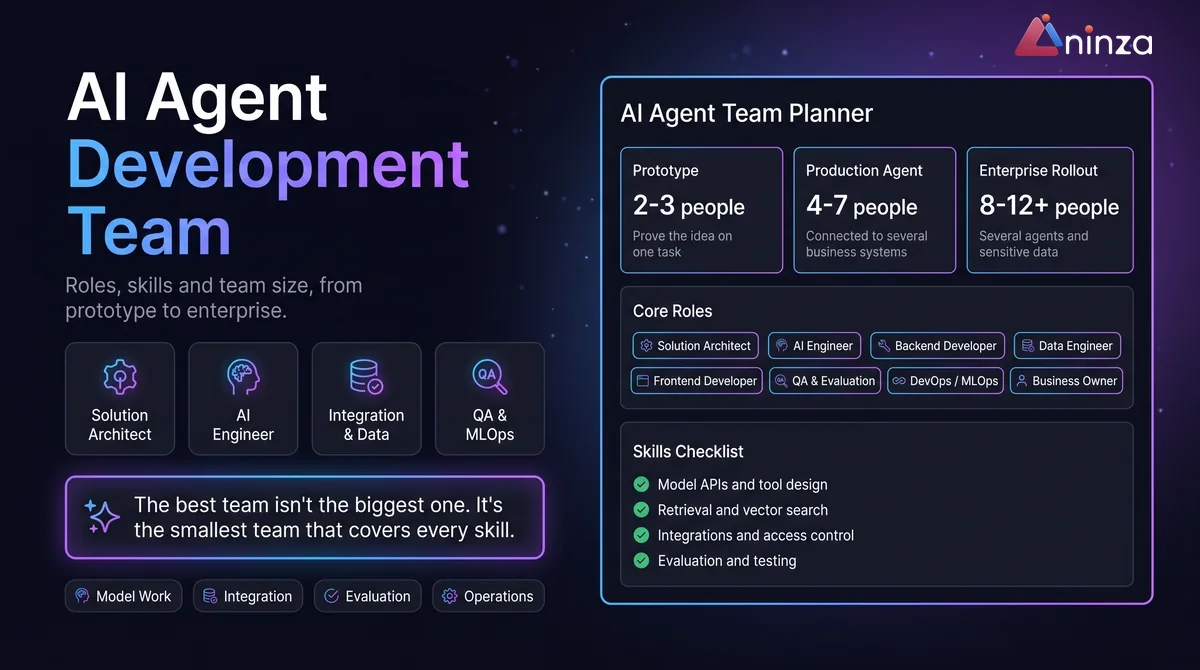
| Stage | Team size | Typical roles | Good for |
|---|---|---|---|
| Prototype | 2-3 people | An AI engineer with backend skills, a full-stack developer, plus a business owner part-time | Proving the idea works on one task with real examples |
| Production agent | 4-7 people | Architect or lead engineer, one or two AI engineers, backend and frontend developers, QA and evaluation | A support, sales or operations agent connected to several business systems |
| Enterprise rollout | 8-12+ people | All seven roles, plus security, project management and domain experts | Several agents, sensitive data, compliance reviews and high usage |
Start at the smallest size that fits, prove the agent works on one task, then add specialists as the scope grows. Adding people to an agent that doesn’t work yet rarely makes it work sooner.
Skills checklist for the whole team
No single person needs every skill below, but the team as a whole should cover them all before the agent reaches real users.
- Model work: model APIs, prompt and tool design, and choosing between models on cost and quality.
- Retrieval: embeddings, vector databases such as pgvector or Pinecone, chunking and search testing.
- Integration: REST APIs, webhooks, authentication and least-privilege access.
- Evaluation: test sets with known answers, repeated runs and regression testing after every change.
- Security: prompt injection defences, data handling and audit logs.
- Operations: cloud deployment, monitoring, alerting and cost tracking.
- Product: a clear scope, success measures and decisions on what the agent may do.
Python is the most common language for agent work, and TypeScript is a strong second for teams already building on Node.js. The main model SDKs and agent frameworks support both.
How to size the team for your project
Five questions decide most of it:
- Does the agent only read, or does it act? Answering questions from documents needs fewer people than updating records, sending emails or moving money, which need permission design and approval screens.
- How many systems does it touch? Each integration adds backend work and new ways to fail.
- Does it search documents? If yes, plan for data engineering. If it only calls APIs, you may not need it.
- How sensitive is the data? Personal, financial or health data adds security review and stricter testing.
- Who maintains it after launch? Someone has to own monitoring, updates and the test set. Plan for that person from day one.
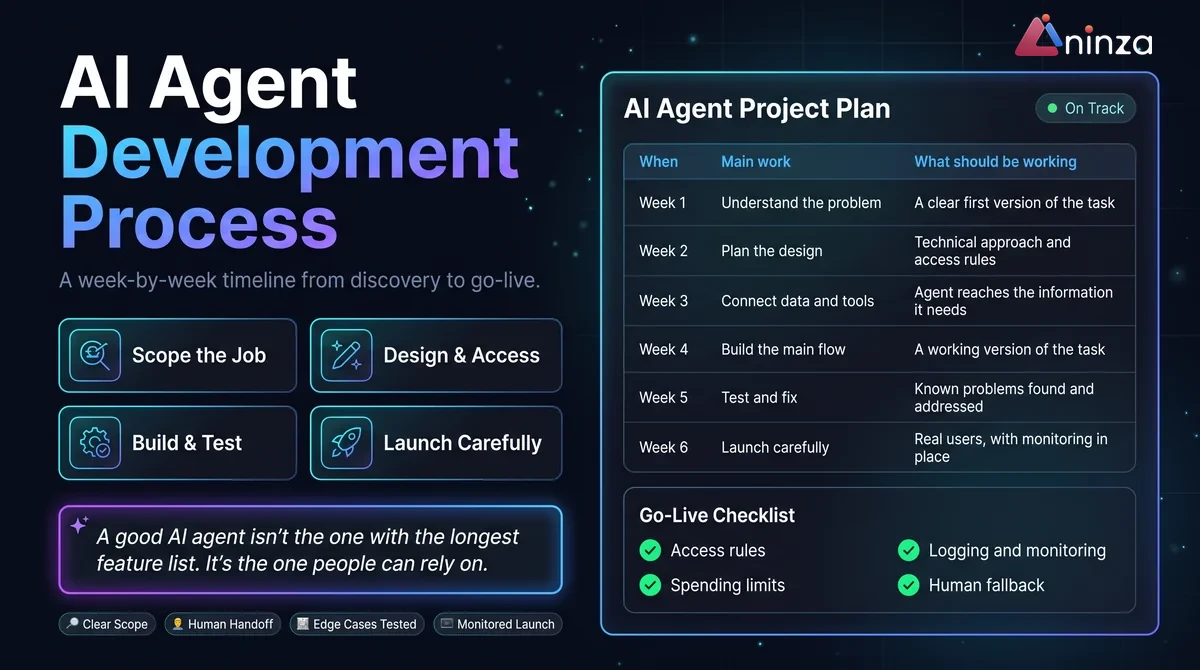
For how these roles fit into a schedule, our week-by-week AI agent development timeline walks through a typical build from discovery to go-live.
Build in-house, hire or work with a partner?
An internal team makes sense when AI is central to your product and you will keep building agents for years. It is slower to start: hiring experienced AI engineers takes time, and a team’s first project is also where it learns.
A partner makes sense when you need one or two agents working soon, or want to prove value before you hire. Many companies mix the two: a partner builds the first agent while the internal team learns alongside, then takes it over.
If you are weighing those options, see how we approach AI agent development, or how dedicated AI engineers can join your team.
Frequently asked questions
How many developers do you need to build an AI agent?
Two or three people can build a working prototype for one task. A production agent connected to several business systems usually needs four to seven. Enterprise programmes with several agents and sensitive data often need eight or more.
Which role matters most?
The AI engineer builds the agent’s decision-making, but no single role carries a project. Many of the hardest problems sit in integrations, permissions and testing rather than in the model, so a balanced team beats a team of AI specialists.
Do you need a data scientist to build an AI agent?
Usually not. Most agents use an existing model through an API, so nobody has to train one. You need a data scientist if the project includes predictive modelling, such as forecasting demand, or if you plan to fine-tune a model on your own data.
What programming language is best for AI agent development?
Python is the most common choice. TypeScript works well for teams already building on Node.js. Both are supported by the main model SDKs and agent frameworks.
How long does it take to build an AI agent?
A focused proof of concept can take a few weeks. A production agent with several integrations, security testing and monitoring usually takes two to three months. Our guide to the AI agent development process breaks this down week by week.
Start small, then add specialists
The best AI agent development team isn’t the biggest one. It is the smallest team that covers model work, integration, testing and operations, with a business owner who can make decisions quickly.
Start with two or three people and one task. Prove the agent works on real examples, then add specialists as the scope grows.
If you would like a second opinion on the team your project needs, talk to our team. We have been building software at Aeologic Technologies since 2015, and AINinza runs AI agents in production today, including voice agents and database tools.