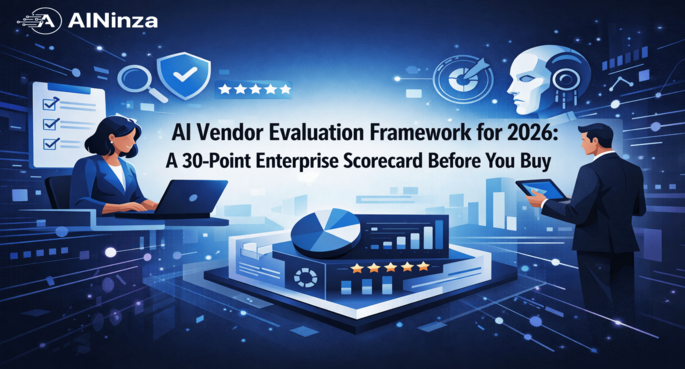
AI Vendor Evaluation Framework for 2026: A 30-Point Enterprise Scorecard Before You Buy

If you are evaluating AI vendors in 2026, the hard part is not finding demos. It is surviving them.
Every vendor can show a slick copiloted workflow, a dashboard with suspiciously perfect numbers, and a promise that your team will be in production in six weeks. Then the real project starts. Security reviews drag. integration turns ugly. Adoption stalls. Finance asks where the ROI is. Legal asks where the data goes. Your operations team quietly asks who is going to maintain this thing once the implementation partner disappears.
That is why enterprise AI buying needs a stricter filter than a normal software procurement process. AI systems are not just another SaaS line item. They affect workflow design, data governance, compliance posture, model behavior, support risk, and downstream cost structure. A cheap pilot can become an expensive operational mess if you buy the wrong architecture.
This guide gives you a practical AI vendor evaluation framework built for enterprise buyers, operators, and transformation leads. It is designed to help you compare vendors beyond marketing fluff, assign weighted scores, and make a decision that can survive procurement, delivery, and scale.
The short version is this: if a vendor cannot clearly answer how value is measured, how data is protected, how outputs are controlled, and how the system integrates into your current stack, you do not have a solution. You have a demo with a sales team attached.
Why AI vendor selection is harder than normal SaaS selection
Traditional software buying usually centers on feature fit, price, implementation effort, and vendor viability. Those still matter. But AI adds a few complications that punish lazy procurement.
First, outcomes are probabilistic. Even strong systems can vary by prompt design, retrieval quality, model choice, and human review flow. Second, AI depends heavily on your data environment. A vendor can look brilliant in a sandbox and fail miserably once exposed to your taxonomy, messy documents, approval chains, and real users. Third, governance matters earlier. With AI, security, privacy, explainability, and fallback controls cannot be postponed to phase two.
This is also happening in a market where buyers are under pressure to move fast. McKinsey reported in 2025 that organizations are beginning to rewire structures and processes to capture gen AI value, but only a small share are seeing material enterprise-wide impact. IBM’s 2023 Global AI Adoption Index found 42% of enterprise-scale organizations had actively deployed AI, while another 40% were still exploring or experimenting. In plain English, the market is noisy, budgets are real, and most teams are still figuring out what good looks like.
That is exactly why a scorecard matters. It forces disciplined comparison before you sink time into pilots, procurement cycles, and integration work.
The four buyer mistakes that waste the most money
Before the scorecard, it is worth naming the failure patterns it exists to prevent. In our experience these four account for most of the wasted spend in enterprise AI procurement.
1. Buying the demo instead of the operating model
Every vendor demo works. It was built to. The demo runs on clean data, a narrow happy path, and a scenario the vendor chose. What you are actually buying is the operating model behind it: how it behaves on your messy data, who maintains it, what happens when it is wrong, and what the workflow looks like on a bad Tuesday. Evaluate the operating model, not the demo.
2. Comparing tools without comparing total cost
Licence cost is the visible number and rarely the largest one. Integration effort, data preparation, internal time, change management, monitoring, and ongoing tuning frequently exceed it. Two vendors with identical licence fees can differ substantially in what they cost you to actually run. Compare twelve-month totals, not line items.
3. Treating “AI platform” as a category with shared meaning
The phrase covers products that have almost nothing in common: model providers, orchestration layers, vertical applications, and consultancies with a wrapper. Comparing them on a single spec sheet produces a false equivalence. Define the category you are actually buying before you compare anyone.
4. Leaving security and governance until procurement week
This is the most expensive scheduling mistake in enterprise AI. A vendor that cannot answer data residency, retention, model training, and access control questions will fail security review, and discovering that in week ten wastes the entire evaluation. Ask in week one, when the answer is still cheap.
The 30-point enterprise AI vendor scorecard
Use a 1 to 5 score for each category, then multiply by the weight. A perfect score is 100.
| Category | Weight | What to evaluate |
|---|---|---|
| Business outcome fit | 20 | Can the vendor solve a measurable business problem with clear KPIs? |
| Data security and privacy | 15 | Data handling, retention, encryption, isolation, residency, and admin controls |
| Integration and workflow fit | 15 | APIs, connectors, identity, ERP/CRM/helpdesk compatibility, event handling |
| Governance and risk controls | 10 | Audit trails, explainability, approval layers, human-in-the-loop, policy controls |
| Implementation readiness | 10 | Time to value, onboarding effort, internal dependencies, vendor services quality |
| Cost structure and ROI model | 10 | Pricing clarity, token or usage economics, support cost, scale cost, savings assumptions |
| Vendor maturity and support | 10 | Customer evidence, roadmap credibility, support SLAs, documentation, partner ecosystem |
| Change management and adoption | 10 | UX quality, training burden, admin usability, user trust, rollout support |
A vendor in the 80+ range is usually worth serious due diligence. A vendor in the 65 to 79 range may still work, but only with a tightly scoped use case and risk controls. Under 65, you are probably paying to discover problems you could have spotted upfront.
1. Business outcome fit, the scorecard starts here
This is the most important section because a technically impressive tool can still be commercially useless.
Ask the vendor to define, in writing, the primary business outcome. Not a vague line like “improve productivity.” Force them to anchor value to a number: lower average handling time by 20%, reduce document processing effort by 50%, cut onboarding cycle time from 10 days to 4, improve lead qualification throughput by 3x, or reduce L1 ticket volume by 30%.
Then ask what assumptions sit underneath that claim.
A serious vendor should be able to answer:
– Which workflow is being changed?
– Which team owns the process today?
– Which baseline metric are we comparing against?
– How long until measurable value appears?
– What operational preconditions must be in place?
If the vendor cannot define baseline, target, owner, and measurement window, the ROI story is fantasy.
One useful benchmark here comes from Microsoft’s 2024 Work Trend Index, which found that many organizations are pushing AI use broadly, but leaders still struggle to turn experimentation into durable work redesign. That gap matters. Enterprise value comes from workflow change, not from novelty.
2. Security and privacy, where most fake confidence collapses
This section should eliminate a surprising number of vendors.
At minimum, you want direct answers on these points:
– Is customer data used for model training by default?
– Can data retention be disabled or customized?
– What encryption standards apply at rest and in transit?
– Is tenant isolation documented?
– Does the vendor support SSO, SCIM, RBAC, and audit logging?
– Can the vendor meet your residency and compliance requirements?
– How are prompts, uploaded files, and output logs stored?
– What subprocessors are involved?
NIST’s AI Risk Management Framework is useful here because it forces a broader trust lens. You are not only managing cyber risk. You are managing validity, reliability, privacy, accountability, and downstream harm. If a vendor treats security as a PDF attachment instead of an operating discipline, walk away.
A good enterprise signal is when the vendor can show control ownership clearly. A bad signal is when every answer becomes “that depends on the model provider.” If they are selling an enterprise solution, dependency opacity is their problem, not yours.
3. Integration and workflow fit, because standalone AI tools rarely survive
Most AI tools die from workflow irrelevance, not algorithm weakness.
Your team should map the target process end to end before the final shortlist. Where does data come from? Where does the model output go? Who approves it? What systems need updates? What triggers the task? What happens if the model is uncertain or wrong?
Evaluate vendors on practical integration questions:
– Do they have robust APIs and webhooks?
– Can they connect to your CRM, ERP, ticketing, or document systems without custom chaos?
– Do they support structured input and output schemas?
– Can they work with your identity stack?
– What is the fallback when an upstream system is unavailable?
– Can you export logs and events for observability?
Stanford’s AI Index continues to show how fast enterprise investment is expanding, but scaling value still depends on implementation discipline. Integration is where that discipline gets tested.
The rule is simple: if the product only works inside the vendor’s demo environment, it is not enterprise-ready.
4. Governance and human control, the difference between adoption and backlash
A vendor should be able to explain how humans stay in control.
This matters in customer support, sales operations, knowledge systems, legal review, procurement workflows, and any process where a bad output can create financial or reputational damage. Governance is not just about satisfying compliance teams. It is about maintaining operational trust.
Look for:
– Configurable approval steps
– Confidence thresholds or escalation rules
– Versioning for prompts, workflows, and models
– Output traceability
– Feedback loops and correction workflows
– Policy enforcement for sensitive actions
– Clear guardrails around autonomous actions
IBM’s survey found 85% of IT professionals believed consumers are more likely to choose services from companies with transparent and ethical AI practices, but far fewer organizations had strong bias reduction, provenance, or explainability mechanisms in place. That gap is your buying opportunity. Vendors with mature governance will be easier to scale because they will trigger less internal resistance.
5. Implementation readiness, where timelines become honest
Most enterprise AI timelines are fake in the first sales call.
A better way to assess readiness is to break implementation into four stages:
1. Discovery and workflow mapping
2. Data and integration setup
3. Pilot with acceptance criteria
4. Controlled rollout with monitoring
Ask the vendor for a realistic 30-60-90 day plan. Not a generic onboarding deck. A real plan with named dependencies from both sides. You want to know:
– What internal SME time is required per week?
– Which systems need admin access?
– What data cleanup is necessary?
– What must be available before pilot launch?
– What defines pilot success or failure?
– What resources remain after go-live?
Deloitte’s State of Generative AI in the Enterprise research has repeatedly shown that organizations face adoption friction around risk, governance, talent, and scaling mechanics. So when a vendor says implementation is “plug and play,” hear that as “we have not done enough enterprise implementations to know where this breaks.”
6. Cost structure and ROI, because cheap pilots can become expensive habits
Enterprise buyers often compare subscription prices and miss the actual cost stack.
Your evaluation model should include:
– Platform or license fees
– Usage-based costs such as tokens, API calls, storage, or overages
– Implementation services
– Internal engineering and admin time
– Security and legal review overhead
– Monitoring and QA effort
– Ongoing prompt/workflow maintenance
– Support tier upgrades
For ROI, insist on a simple formula:
Annual value created – annual total cost = net impact
Where possible, quantify both hard and soft value. Hard value might include labor saved, lower rework, reduced response times, or avoided outsourcing spend. Soft value might include faster decision cycles or better coverage, but soft value should never carry the whole business case.
Use scenario bands, not one heroic estimate. Model conservative, expected, and upside cases. If the economics only work in the upside case, the vendor probably does not belong on the shortlist.
7. Vendor maturity and support, because you are buying a relationship
In 2026, many AI vendors still look better in marketing than in delivery. That is normal. It is also dangerous.
You should assess maturity across six practical signals:
– Relevant customer references, ideally in similar process complexity
– Quality of documentation and admin controls
– Product roadmap stability
– Responsiveness of technical support
– Depth of implementation partner bench
– Evidence of shipping beyond pilots
Ask for customer references that are not just logo drops. You want operational references. What broke? How long did rollout take? How much internal effort was needed? What would they do differently?
G2 or Gartner peer feedback can be useful inputs, but do not outsource judgment to review platforms. A reference call with a blunt operator will teach you more in 20 minutes than twenty polished case studies.
8. Change management and user adoption, the silent killer
Here is the dirty secret in enterprise AI: a tool can be technically sound and still fail because users do not trust it, managers do not reinforce it, or admins cannot maintain it.
Evaluate the vendor’s adoption model:
– How intuitive is the user experience?
– Does the tool fit how the team already works?
– Are outputs easy to verify?
– Can frontline users correct errors without creating IT tickets?
– Does the vendor provide role-based training and rollout templates?
– Are analytics available for usage, drift, and exception handling?
PwC’s 2025 AI Jobs Barometer points to a labor market increasingly shaped by AI exposure, but that does not mean employees magically adopt new systems. Adoption happens when the product reduces friction, not when leadership sends an email about innovation.
Should enterprises prefer platform vendors or specialist vendors?
It depends on how many use cases you have. A platform amortises across several; a specialist usually delivers a single use case better and faster. Choosing a platform for one use case means paying for flexibility you will not use.
How should buyers compare AI vendor pricing models?
Convert every model to a twelve-month total at your expected volume, including internal effort. Per-seat, per-usage, and flat-fee models are not comparable in their native form, and vendors rarely present them in the form that flatters a competitor.
What security controls are non-negotiable?
A written position on training-data usage, documented data residency, access control enforced at the data layer, audit logging you can query, and a defined incident notification commitment. A vendor missing any of these is not ready for enterprise deployment.
How long should an AI pilot run?
Four to eight weeks for most use cases, with success criteria agreed before it starts. Longer pilots rarely produce more information; they produce sunk cost and a reluctance to say no.
The scored 30-point rubric
The dimensions above describe what to look for. This turns them into a number you can compare across vendors. Score each criterion 0, 1, or 2: 0 means absent or evasive, 1 means partial or promised, 2 means demonstrated with evidence. Maximum 60 points across 30 criteria.
Require evidence for every 2. A confident answer is not evidence.
Section 1: Business fit and ROI credibility
- Problem-solution fit. Can the vendor restate your problem more precisely than you did, and does the product address it directly rather than adjacently?
- Time-to-value realism. Is the stated timeline consistent with comparable deployments, or does it assume everything goes right?
- ROI model quality. Is the business case built from your numbers, or from a generic industry template?
- Benchmark evidence. Are performance claims supported by results on data resembling yours?
- Buyer-side effort clarity. Has the vendor been explicit about what your team must contribute in hours and roles?
Section 2: Delivery and implementation competence
- Integration capability. Demonstrated experience with your specific systems, not a generic connector list.
- Data readiness approach. Do they assess your data honestly, including telling you when it is not ready?
- Workflow design depth. Do they understand the process being changed, or only the software?
- Human-in-the-loop design. Are review, override, and escalation designed in rather than bolted on?
- Change management support. Is adoption treated as part of delivery or left entirely to you?
Section 3: Technical architecture and scalability
- Model strategy. Is the choice of model reasoned and replaceable, or fixed and unexplained?
- Retrieval and knowledge design. For anything touching your documents or data, is grounding and citation built in?
- Latency and throughput. Are performance expectations stated concretely and tested at your volumes?
- Monitoring and observability. Can you see what the system is doing in production without asking the vendor?
- Portability and lock-in risk. If you leave in two years, what can you take with you?
Section 4: Security, privacy and governance
- Data residency and processing location. Documented, and compatible with your obligations.
- Training data usage. Explicit written position on whether your data trains their models.
- Access control granularity. Permissions enforced at the data layer, not the interface.
- Audit and traceability. Can you reconstruct what the system did and why, months later?
- Compliance posture. Certifications relevant to your industry, evidenced rather than asserted.
Section 5: Commercial and vendor risk
- Pricing transparency. Is the model comprehensible and predictable as usage grows?
- Twelve-month total cost. All-in, including your internal effort.
- Contract flexibility. Exit terms, scope changes, and what happens if the pilot fails.
- Vendor stability. Funding, customer base, and realistic assessment of longevity.
- Reference quality. References doing something comparable to what you intend, in a comparable environment.
Section 6: Adoption and long-term fit
- User experience. Will the people expected to use it actually choose to?
- Training and enablement. What is provided, and is it sufficient for your team’s starting point?
- Support model. Response times, escalation, and who you reach at 2am.
- Roadmap alignment. Is their direction compatible with yours, or are you an edge case?
- Failure handling. What the vendor does when the system is wrong, which is the question that separates serious vendors from optimistic ones.
Reading the score
- 50 to 60. Strong candidate. Proceed to pilot.
- 40 to 49. Viable with identified gaps. Address them contractually before signing.
- 30 to 39. Significant risk. Only proceed if the gaps are ones you can genuinely absorb.
- Below 30. Do not proceed, regardless of how good the demo was.
Weight sections to your context. A regulated business should weight Section 4 more heavily; a company with a thin internal team should weight Section 2.
Benchmarks that actually matter during evaluation
Vendors will offer benchmarks. Most are chosen because the vendor performs well on them. Four measures are worth more than any published figure.
Accuracy on your data, not theirs. Supply a representative sample including the awkward cases. Performance on a curated public set predicts very little about performance on your records.
Failure behaviour. What happens when the system does not know? A system that says so is materially safer than one that guesses fluently. Test this deliberately.
Latency at your volume. Response times measured at demo scale rarely survive production load. Ask for figures at your expected concurrency.
Consistency over time. Run the same evaluation twice, a week apart. Variation you cannot explain is a warning about the operational discipline behind the product.
Field reality, what fails in real projects and why
The most common failure mode is not model quality. It is procurement optimism.
A company buys an AI platform because the demo looks strong. The pilot works on clean sample data. Then the live environment introduces legacy naming conventions, inconsistent documents, missing permissions, approval bottlenecks, and frontline skepticism. Suddenly the promised “80% automation” drops to something far less glamorous, like “we partially speed up one subtask when the inputs are clean and an analyst is babysitting the outputs.”
That does not mean AI failed. It means the buying process ignored operational reality.
The fix is brutally simple: score vendors against the workflow you actually run, not the one the sales deck pretends you run. Include operations, security, legal, and the team that will own the process after launch. If those voices show up late, your project will pay for it.
A simple enterprise decision flow
If you want a cleaner selection process, use this flow:
Step 1: Define one use case, one owner, one KPI
Do not evaluate vendors at the category level. Evaluate them against a specific use case like support deflection, sales proposal drafting, document intake, or knowledge retrieval.
Step 2: Shortlist three vendors maximum
More than three creates decision fatigue and fake precision.
Step 3: Make vendors complete the same scorecard
Do not let each vendor steer the process. Make them answer the same technical, commercial, and operational questions.
Step 4: Run a controlled pilot with acceptance criteria
Examples: 25% reduction in processing time, under 5% critical error rate, integration with CRM complete, approval audit trail available.
Step 5: Decide based on deployment readiness, not pilot theater
The winner is not the vendor with the prettiest demo. It is the vendor most likely to survive rollout, governance, and scale.
Recommended score thresholds for buyers
Use this simple interpretation:
- 85 to 100: Strong enterprise fit. Proceed to security review and commercial negotiation.
- 75 to 84: Good candidate, but verify weak spots before rollout.
- 65 to 74: Only proceed with a constrained pilot and hard exit criteria.
- Below 65: Drop from consideration.
You can also add knockout criteria. For example, automatic disqualification if there is no SSO support, no audit logging, no documented data policy, or no credible ROI model.
How to run a 30-day vendor bake-off without wasting a month
Long evaluations lose momentum and produce worse decisions than short structured ones. Four weeks is enough if it is organised.
Week 1: Scope and data preparation
Define one use case, one success metric, and one internal owner. Prepare a representative data sample including edge cases. Share identical materials with every vendor. Differences in what you give them make the results incomparable.
Week 2: Technical setup
Each vendor configures against the same scope. Track what setup actually requires from your team, because that effort is part of the cost and it varies enormously between vendors.
Week 3: Evaluation
Run the same test set against every vendor. Score against the 30-point rubric. Include the failure cases, not just the happy path, and have the eventual users participate rather than only the evaluation team.
Week 4: Executive decision
Present scores, twelve-month total cost, and identified risks. Decide. A bake-off that does not end in a decision has cost you a month and taught you nothing you will still remember next quarter.
The discipline that makes this work is giving every vendor identical inputs. Bespoke scoping per vendor makes comparison impossible.
The questions procurement, security, and operations should ask in the final round
Bring each function in with its own questions rather than delegating everything to whoever ran the evaluation.
Procurement
- What is the total twelve-month cost including our internal effort?
- How does pricing change as usage grows, and what is the worst realistic case?
- What are the exit terms, and what do we retain if we leave?
- What happens commercially if the pilot does not meet its success criteria?
Security
- Where is our data processed and stored, and under whose jurisdiction?
- Is our data ever used to train models, including in aggregate or anonymised form?
- How is access controlled, and is it enforced at the data layer?
- What is the incident response process and notification commitment?
- What independent security assessment can you evidence?
Operations and IT
- What does integration require from our team, in hours and in named roles?
- How do we monitor this in production without depending on you?
- What is the support model, and what are the actual response times?
- What is the upgrade path, and how much notice do we get for breaking changes?
Business owner
- What must change in how my team works?
- What does the system do when it is wrong, and who notices?
- What will we measure in 90 days to know this worked?
- Who owns this after the vendor’s implementation team leaves?
Red flags that should end a deal
Some findings are worth ending an evaluation over, however impressive the product.
- Evasion on data handling. If training-data usage or residency cannot be answered clearly and in writing, the answer you do not like is the true one.
- Accuracy claims without conditions. Any performance figure quoted without describing the data and the task is marketing.
- No failure story. A vendor who cannot describe a deployment that went badly either lacks experience or is not being straight with you.
- Resistance to a structured pilot. Serious vendors welcome a defined evaluation. Reluctance suggests the product performs best under controlled conditions.
- Pricing that cannot be forecast. If you cannot model next year’s cost, you are signing an open commitment.
- Reference calls that are all champions. Ask for a customer who churned, or one whose project underperformed. The response tells you a great deal.
- The team you meet is not the team you get. Confirm who actually delivers, and put it in the contract.
What a strong vendor usually looks like
The positive pattern is consistent.
- They narrow the scope rather than expanding it, and tell you which parts are not worth doing.
- They ask about your data early and are honest when it is not ready.
- They quantify your effort, not just theirs.
- They define the success metric with you before the pilot, and accept a go or no-go gate.
- They describe failure modes without being pressed.
- They make monitoring your capability, not a dependency on them.
None of that is about model sophistication. It is about operational maturity, which is what determines whether a project ships.
FAQ
What is the best AI vendor evaluation framework for enterprise buyers?
The best framework scores vendors on business outcome fit, security, integration, governance, implementation readiness, ROI, vendor maturity, and adoption support. If your framework only compares features and price, it is incomplete.
How many AI vendors should an enterprise compare at once?
Three is usually enough. More than that creates noise, slows procurement, and makes demos harder to compare fairly.
What should be a red flag during AI vendor evaluation?
Big red flags include vague ROI claims, weak data policies, no human-in-the-loop controls, poor integration depth, and implementation timelines that ignore internal dependencies.
Should enterprises run paid pilots before selection?
Sometimes, yes. But only if the pilot has explicit success metrics, a time box, and a clear path to rollout. Otherwise you are just funding the vendor’s product discovery.
How do you measure AI vendor ROI?
Measure baseline process cost or cycle time, compare against post-implementation performance, include all direct and indirect costs, and model conservative as well as expected outcomes.
References
- McKinsey, The state of AI: How organizations are rewiring to capture value (2025) – https://www.mckinsey.com/capabilities/quantumblack/our-insights/the-state-of-ai-how-organizations-are-rewiring-to-capture-value
- IBM, Global AI Adoption Index 2023 press release (2024) – https://newsroom.ibm.com/2024-01-10-Data-Suggests-Growth-in-Enterprise-Adoption-of-AI-is-Due-to-Widespread-Deployment-by-Early-Adopters
- NIST, AI Risk Management Framework – https://www.nist.gov/itl/ai-risk-management-framework/
- NIST, AI RMF 1.0 PDF – https://tsapps.nist.gov/publication/get_pdf.cfm?pub_id=936225
- Stanford HAI, AI Index Report 2025 – https://aiindex.stanford.edu/report/2025
- Stanford HAI, AI Index Report 2025 PDF – https://hai.stanford.edu/assets/files/hai_ai_index_report_2025.pdf
- Microsoft, 2024 Work Trend Index Annual Report – https://www.microsoft.com/en-us/worklab/work-trend-index
- Deloitte, State of Generative AI in the Enterprise – https://www2.deloitte.com/us/en/pages/consulting/articles/state-of-generative-ai-in-the-enterprise.html
- PwC, 2025 Global AI Jobs Barometer – https://www.pwc.com/gx/en/issues/artificial-intelligence/job-barometer.html
- OECD, AI Principles overview – https://oecd.ai/en/ai-principles
Conclusion
Buying AI well is less about spotting the flashiest product and more about reducing the chance of an expensive mistake. The right vendor will connect measurable value to a realistic implementation path, show disciplined security and governance controls, fit your workflow architecture, and remain supportable after the pilot excitement dies down.
If you use a structured scorecard, force hard answers, and test against real operational conditions, you will make faster and better buying decisions. That is the point. Not more demos. Better decisions.
AINinza is powered by Aeologic Technologies. If you want help evaluating AI vendors, designing a pilot that produces actual business value, or building an AI rollout roadmap that survives procurement and production, talk to the Aeologic team: https://aeologic.com/